AI Citation Gap Statistics: UK 2026


Send to your email
Enter your email below and a link to download the PDF of this article will be sent directly to your inbox.

As AI is increasingly integrated into applications, more people are using it for its advanced search capabilities. While this benefits users, it can create challenges for brands. Visibility in AI is becoming just as important as visibility in traditional search, and brands that aren't being cited risk losing awareness, credibility, and potential customers to competitors that are.
To find out what 17,398 opinions of B2B marketing revenue leaders in the UK were about the AI citation gap, we utilised AI-driven audience profiling to synthesise insights from online discussions over 12 months, ending on July 7th, 2026, to a high statistical confidence level. Looking at what our audience has to say about the subject, we found both encouraging and worrying views and insights around their awareness of the gap, how they measure it, whether they’re concerned about it, how frequently they’re affected by inaccurate citations, what’s preventing them from closing the gap, and other aspects of this important topic.
Index
- Methodology and data
- 43% of B2B marketing revenue leaders only recently became aware of the AI citation gap, 29% are not aware of this gap at all, and 29% are unsure what the AI citation gap means
- 98% of B2B marketing revenue leaders do not know what their brand’s AI citation gap is, or they don’t measure it, while just 2% say their gap is non-existent
- 91% of B2B marketing revenue leaders agree that the AI citation gap is a bigger concern than SEO, yet it's a smaller concern for 6%, and not a formal priority for 3% so far
- Microsoft Copilot clearly leads the way with the widest AI citation gap for 9% of B2B marketing revenue leaders, 60% think it's possibly the leader, and 17% don’t think it's really leads in this regard, while 7% say ChatGPT is possibly the leader, 3% agree Perplexity is definitely not the leader, and 2% think Google AI overviews possibly lead the way; just 2% haven’t identified which AI platform has the biggest gap
- A lack of structured content is a major driver behind the AI citation gap for 24% of B2B marketing revenue leaders, and it’s somewhat a factor for 35%, while 41% of leaders are unsure of the cause of the AI citation gap
- While 40% of B2B marketing revenue leaders don’t monitor how often inaccurate citations are widening the AI citation gap, 38% find they happen rarely, 6% occasionally, and 8% never, as far as they know, but 8% mention inaccuracies frequently widen the gap
- Unclear measurement standards are a minor blocker for closing the AI citation gap for 60% of B2B marketing revenue leaders; however, 40% of leaders don’t have any blockers, as they have closed this gap
- 36% of B2B marketing revenue leaders currently measure their AI citation gap with agency reporting, and 32% rely on manual prompt testing, yet 32% don’t measure the gap at all
- Share of AI voice is a very important KPI for 37% of B2B marketing revenue leaders tracking the AI citation gap, and it’s somewhat relevant to 54%, and for 9% of leaders, brand accuracy is a somewhat relevant KPI
- Optimisation as a way to close the AI citation gap, 16% are using AI for customer service automation, and 5% are using it for data or insight analysis; however, 6% are not yet using AI to close the AI citation gap
- 63% of B2B marketing revenue leaders are very unlikely to increase their spend on the AI citation gap, but 37% are very likely to increase theirs in the face of rising competition
- Preparing for the future of AI search
Methodology and data
Sourced using Artios from an independent sample of 17,398 opinions of B2B marketing revenue leaders in the UK across X, Quora, Reddit, Bluesky, TikTok, and Threads. Responses are collected within a 95% confidence interval and 5% margin of error. Results are derived from what people describe online, from opinions expressed, not actual questions answered by people in the sample.
How aware are B2B marketing revenue leaders of the AI citation gap?
43% of B2B marketing revenue leaders only recently became aware of the AI citation gap, 29% are not aware of this gap at all, and 29% are unsure what the AI citation gap means
Minding the gap has a new meaning:

A significant citation gap is one of the big issues with AI platforms. AuthorityTech reports that 80% of the sources cited by these platforms do not appear in Google’s top 10 results for the same query. The problem here is that the SERP rankings and the AI citation rate measure completely different realities. This leads us to wonder how aware B2B marketing revenue leaders are of the AI citation gap.
Looking at our audience’s conversations, 43% only recently became aware of the gap, while 29% aren’t aware of it at all. It’s not unexpected that almost a third of B2B marketing revenue leaders have no awareness of it, as the gap is not immediately evident. Unless they compared specific AI search results with the results of a Google search for the same query or kept abreast of research about AI searches and citations, they would remain ignorant of it.
Perhaps more alarming is the 29% who are unsure of what the term ‘AI citation gap’ means, as this reflects an unfamiliarity with terms that can have a major impact on business visibility online.
How big is the AI citation gap for B2B marketing revenue leaders' brands?
98% of B2B marketing revenue leaders do not know what their brand’s AI citation gap is, or they don’t measure it, while just 2% say their gap is non-existent
Lack of gap size awareness is almost unanimous:

98% of B2B marketing revenue leaders do not measure or do not know what the AI citation gap for their brand is. This tells us they’ve never looked into it, which aligns with what we saw above about our audience’s awareness that such a gap exists.
According to Semrush, 62% of AI citations are ghost citations, meaning that B2B marketing revenue leaders’ sites receive a source link, but the AI platform never mentions the site name in its answer to the query. It’s worth noting that each AI platform behaves differently, with Gemini naming brands in the text 84% of the time but citing them as a source only 21% of the time, while ChatGPT names brands 21% of the time and cites them as a source 87% of the time.
The citation gap is non-existent for the remaining 2% of our audience. This segment may be among those who recently became aware of the gap and have started measuring it.
How does the AI citation gap compare to SEO gaps for B2B marketing revenue leaders?
91% of B2B marketing revenue leaders agree that the AI citation gap is a bigger concern than SEO, yet it's a smaller concern for 6%, and not a formal priority for 3% so far
AI is creating bigger challenges than SEO:

The AI citation gap isn’t the only one that B2B marketing revenue leaders need to be concerned about. Many are also faced with SEO gaps, raising the question of how these two gaps compare. For 91% of our audience, the AI citation gap is a bigger concern than SEO gaps, likely because of the growing popularity of AI searches on platforms such as ChatGPT and their integration into traditional engines such as Google.
6% feel that the AI citation gap is a smaller concern than their SEO gaps, while the remaining 3% explain that comparing AI citation and SEO gaps isn’t yet a formal priority in their organisations.
Search Engine Land found that the top 10 organic pages in a study accounted for 55% of organic sessions but only 29% of large language model (LLM) sessions. This means our audience’s best-performing organic content and their best-performing LLM content are likely different. 49 of the top 100 organic pages had no LLM traffic at all. This illustrates glaring differences between the two that should concern B2B marketing revenue leaders.
Which AI platform reveals the widest AI citation gap for B2B marketing revenue leaders?
Microsoft Copilot clearly leads the way with the widest AI citation gap for 9% of B2B marketing revenue leaders, 60% think it's possibly the leader, and 17% don’t think it's really leads in this regard, while 7% say ChatGPT is possibly the leader, 3% agree Perplexity is definitely not the leader, and 2% think Google AI overviews possibly lead the way; just 2% haven’t identified which AI platform has the biggest gap
One AI platform shows the widest gap:
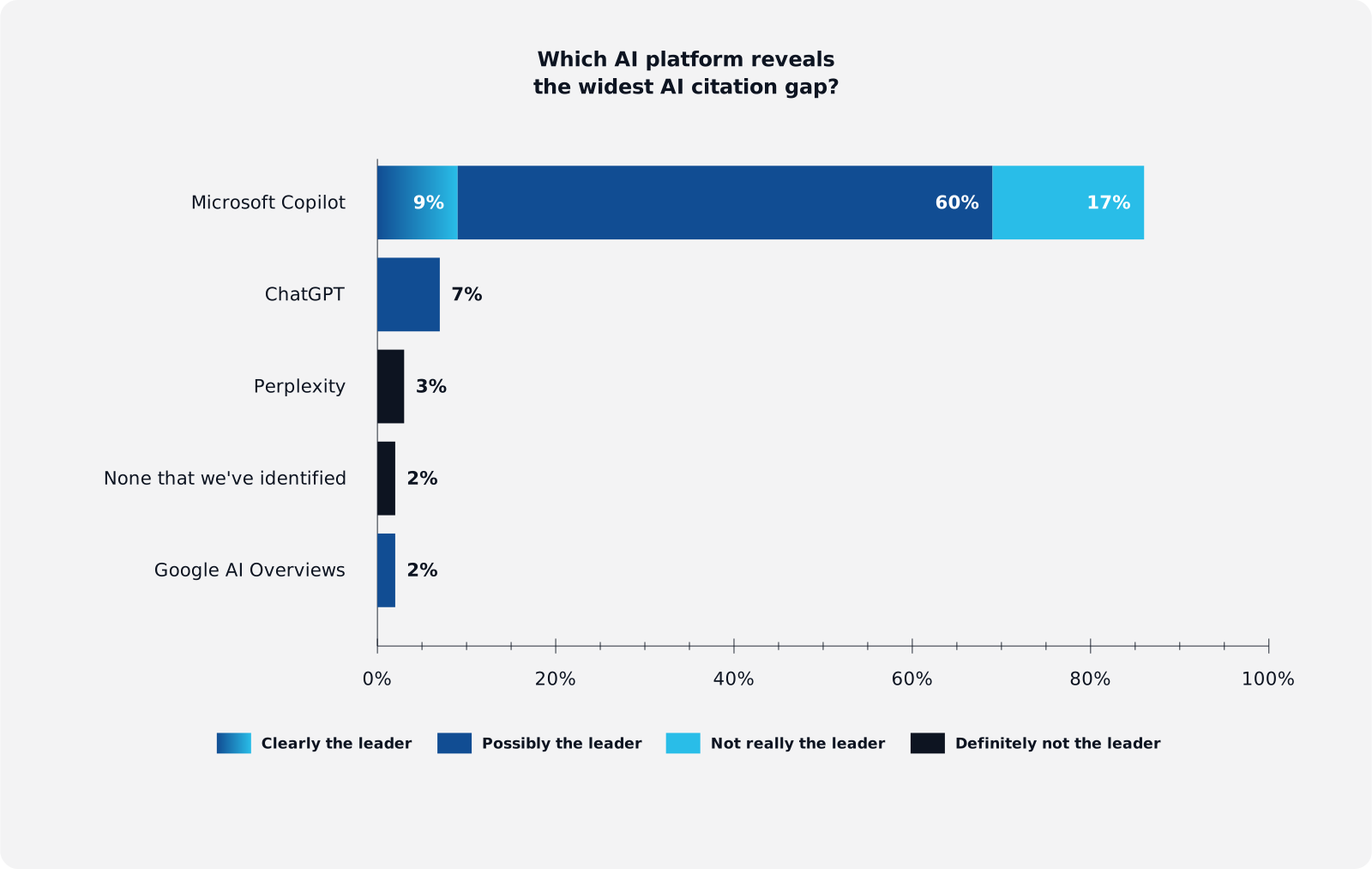
As mentioned, different AI platforms behave differently, which means some have wider citation gaps than others. While the majority of B2B marketing revenue leaders mention Microsoft Copilot in their posts and conversations online, their experiences differ.
9% reckon this platform is clearly the leader, while for 60% it’s possibly the leader. However, 17% say it’s not really the leader. With statistics like these, we can be confident that this platform has the biggest gaps. It’s important to note here that, according to Business of Apps, Microsoft Copilot had 218 million active users across Windows, the app, and the website.
For 7%, ChatGPT is possibly the leader; an opinion that’s possibly based on limited research on their part. The 3% who name Perplexity in their posts indicate that’s definitely not the leader, and 2% explain that none of the platforms they’ve identified is the leader. The remaining 2% feel that Google AI Overviews is possibly the leader, putting the search engine firmly in the minority.
What's driving the AI citation gap for B2B marketing revenue leaders?
A lack of structured content is a major driver behind the AI citation gap for 24% of B2B marketing revenue leaders, and it’s somewhat a factor for 35%, while 41% of leaders are unsure of the cause of the AI citation gap
Lack of content is the main culprit:
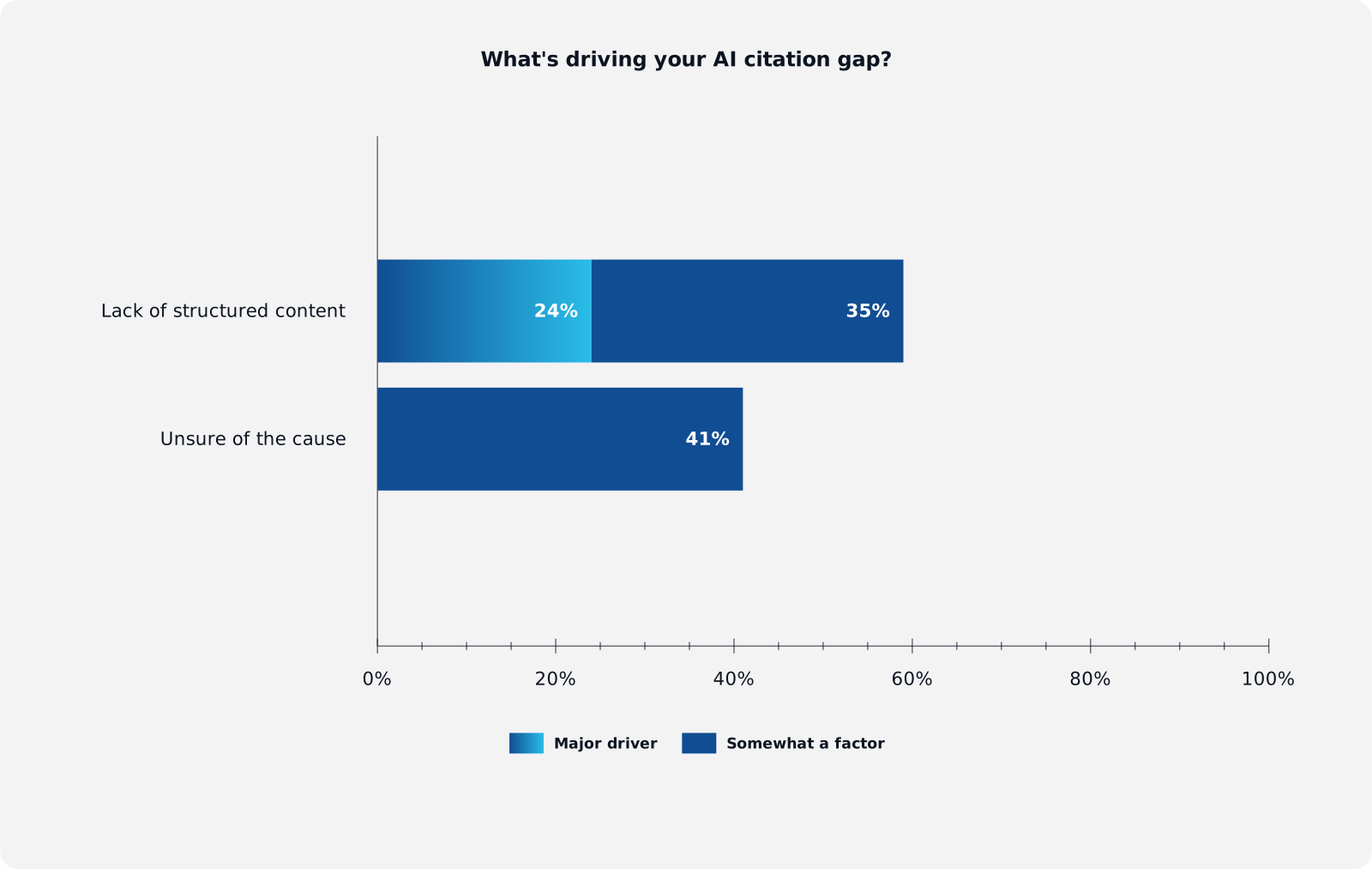
The AI citation gap is driven by various factors, some of which play a greater role than others. For 24% of B2B marketing revenue leaders, a lack of structured content is a major driver of this gap. It’s also somewhat a factor for 35%.
A recent study published in Advances in Artificial Intelligence and Machine Learning helps explain why numerous B2B organisations experience AI citation gaps. Namely, much of their existing content is unstructured, fragmented, and difficult for AI systems to retrieve or reason over.
The remaining 41% of our audience are unsure of the cause that’s driving their AI citation gaps. Whatever it is, this segment thinks it’s only somewhat of a factor.
How often are inaccurate citations widening the AI citation gap for B2B marketing revenue leaders?
While 40% of B2B marketing revenue leaders don’t monitor how often inaccurate citations are widening the AI citation gap, 38% find they happen rarely, 6% occasionally, and 8% never, as far as they know, but 8% mention inaccuracies frequently widen the gap
Inaccurate citations are not a major factor in growing the gap:

Occasionally, AI platforms include inaccurate citations in their results, widening the AI citation gap for B2B marketing revenue leaders. Given the implications, it’s important that these leaders monitor it to determine how frequently this happens. That said, 40% of our audience does not currently monitor how often inaccurate citations widen this gap for them. In contrast, this happens rarely for 38%.
8% reckon it never happens, as far as they know. This segment, however, doesn’t state whether they actively monitor this, so they could be basing their assertion on their assumptions. According to another 8%, inaccurate citations frequently widen the AI citation gap, although the remaining 6% say this happens occasionally.
What's blocking B2B marketing revenue leaders from closing the AI citation gap?
Unclear measurement standards are a minor blocker for closing the AI citation gap for 60% of B2B marketing revenue leaders; however, 40% of leaders don’t have any blockers, as they have closed this gap
Barriers to closure are minimal or eliminated:
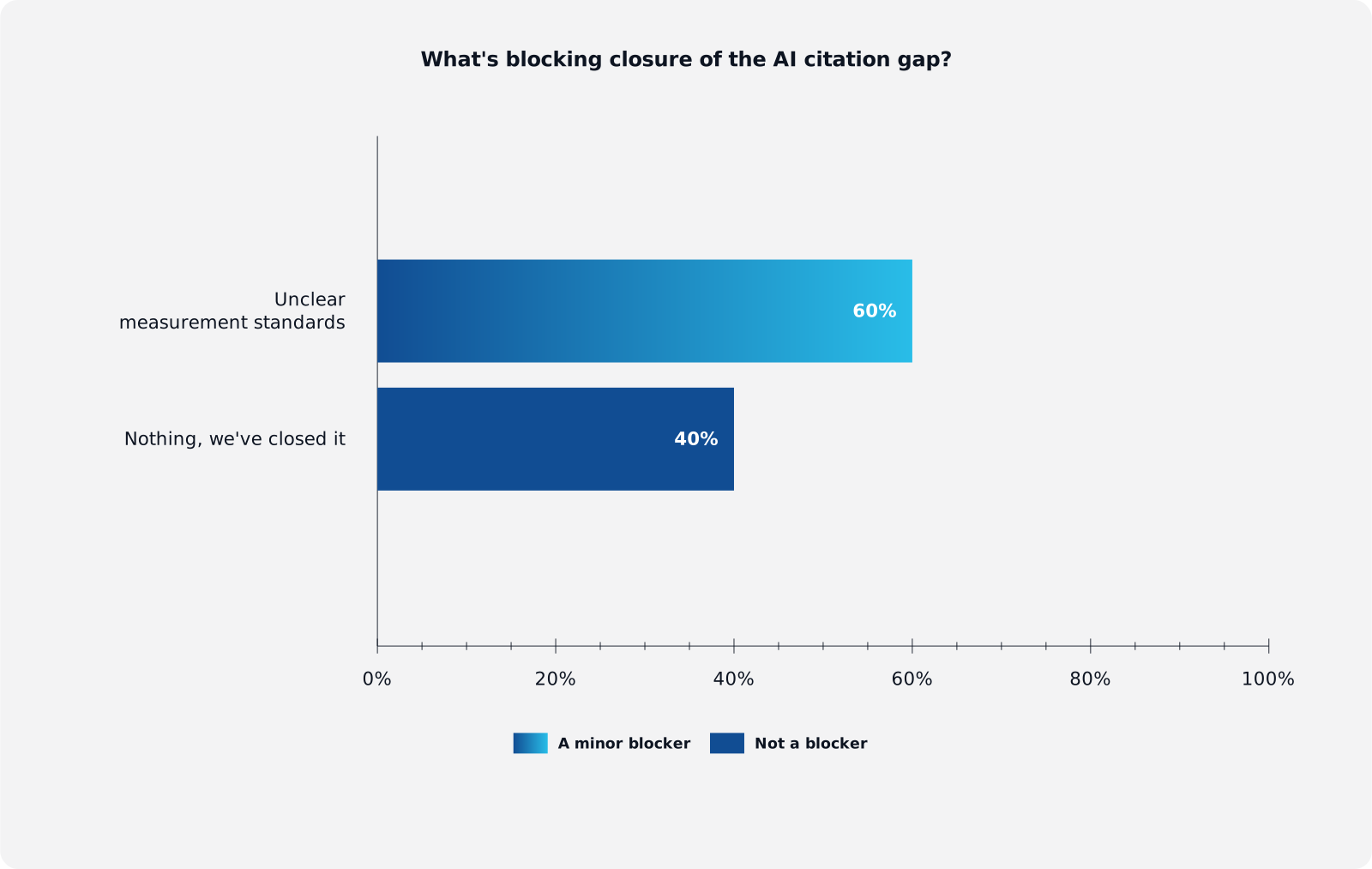
While B2B marketing revenue leaders can take steps to try to close the AI citation gap, their efforts can be hindered by various factors. 60% indicate that unclear measurement standards are a minor blocker to their attempts to close the gap. The remaining 40% claim that nothing is blocking them, as they’ve already closed the gap.
This contradicts some of the statistics we explored above, which makes us wonder whether they have actually dealt with the issue effectively or only think they’ve addressed it.
How do B2B marketing revenue leaders measure the AI citation gap?
36% of B2B marketing revenue leaders currently measure their AI citation gap with agency reporting, and 32% rely on manual prompt testing, yet 32% don’t measure the gap at all
Monitoring is not a standard procedure:

36% of our audience currently use agency reporting to measure the AI citation gap, while 32% rely on manual prompt testing to do this. The remaining 32% do not measure the gap, which aligns with some of the statistics we saw above.
An Emarketer article points out that 28% of the top 1,000 pages cited by ChatGPT have no traditional ranking in Google search results visibility. In addition, only 32% of those pages provide opportunities for brands to influence what information AI includes in its results. Among these, 19% are educational pages, 6% are reviews, 5% are news and media, and 2% are blogs or articles.
YouTube mentions are a stronger indicator of brand visibility than any other factor on platforms such as AI Overviews, ChatGPT, or Google AI Mode. YouTube and other platforms are an enormous influence on how LLMs source and structure their responses. This means user-generated social content and other non-owned assets do more for AI visibility than a brand’s own website.
The implication here is that brands need to optimise their sites and content for AI citations and do more to try to appear in the wider online content network, given how AI search’s results are guided by context.
What KPI matters most to B2B marketing revenue leaders for tracking the AI citation gap?
Share of AI voice is a very important KPI for 37% of B2B marketing revenue leaders tracking the AI citation gap, and it’s somewhat relevant to 54%, and for 9% of leaders, brand accuracy is a somewhat relevant KPI
Measurement focuses on two core metrics:
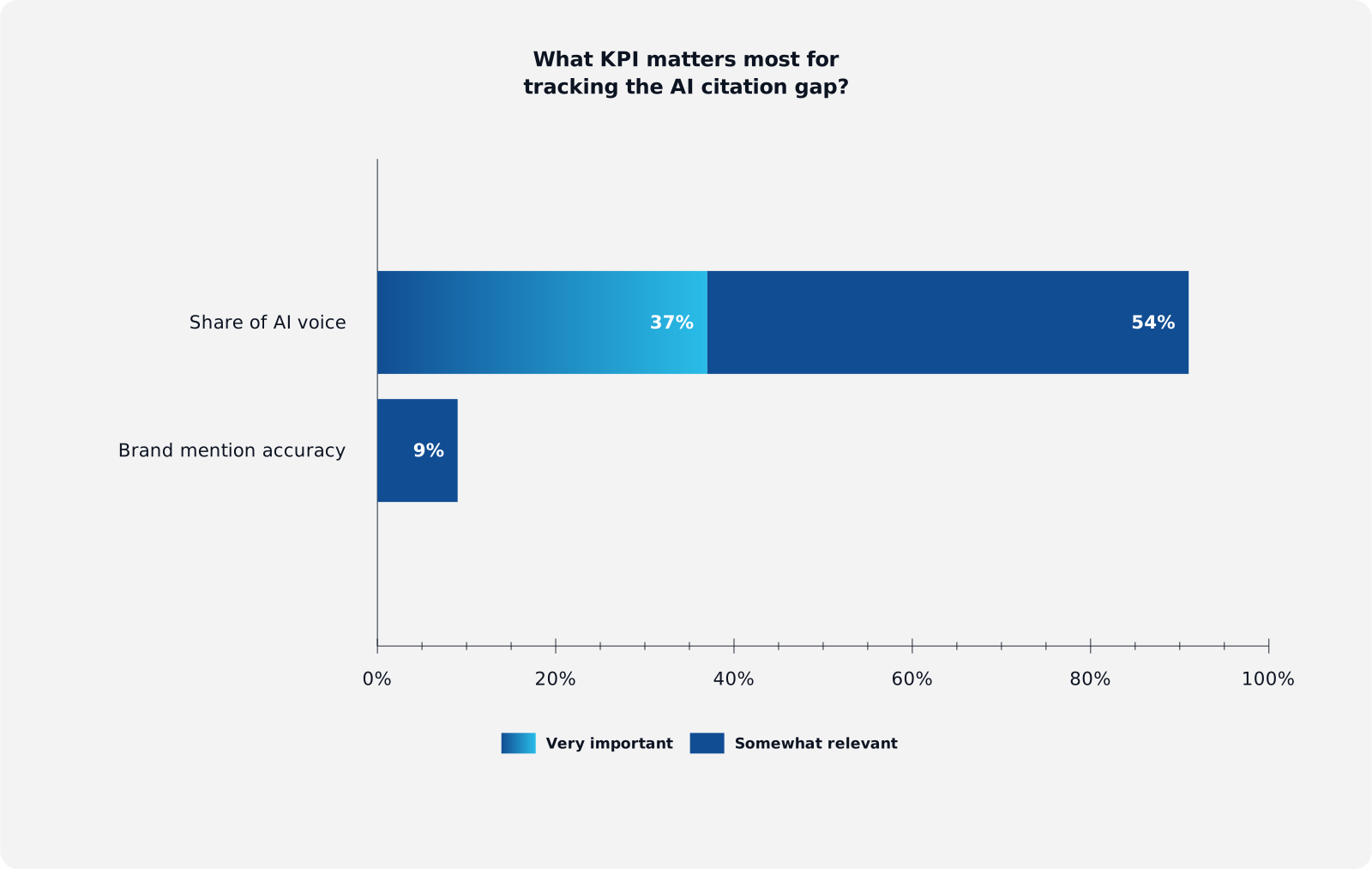
B2B marketing revenue leaders prioritise different key performance indicators (KPIs) when tracking the AI citation gap. Share of AI voice is very important to 37% of our audience and somewhat relevant to 54%. Brand mention accuracy is also somewhat relevant to the remaining 9%.
This makes sense, as according to the Harvard Business Review (HBR), only 8% of the 716 unique brands surfaced in its study appear consistently across ChatGPT, Claude, and Gemini. Most brands appeared on one platform only.
In keeping with what the study we referenced above found, HBR explains that visibility isn’t what determines whether AI platforms recommend them. Instead, what matters is whether an AI platform can arrive at the brand as a credible solution to a specific problem. Different AI platforms are more likely to converge on a brand when its attributes and supporting evidence are clearly structured.
How do B2B marketing revenue leaders use AI to help close the AI citation gap?
73% of B2B marketing revenue leaders are using AI campaign optimisation as a way to close the AI citation gap, 16% are using AI for customer service automation, and 5% are using it for data or insight analysis; however, 6% are not yet using AI to close the AI citation gap
Strategies for closing the gap vary:

While structuring high-quality content properly can go a long way toward closing the AI citation gap, B2B marketing revenue leaders can also use AI to help them do so. Among our audience, 73% do this by using AI for campaign optimisation, while 16% use it to automate customer service. 6% aren’t using AI for this yet, and 5% are using AI for data or insight analysis.
There’s a good reason three of the four segments here use AI for these purposes. Each of these applications generates structured, evidence-based, and customer-informed content that AI platforms are likely to cite. Having said this, it’s important to remember that AI alone won’t increase citation rates directly.
Instead, this technology can help our audience gain a better understanding of customer intent, identify content gaps, structure content more effectively, and improve content quality continually. All this increases the likelihood of being cited by AI platforms.
Are B2B marketing revenue leaders likely to increase spend on the AI citation gap?
63% of B2B marketing revenue leaders are very unlikely to increase their spend on the AI citation gap, but 37% are very likely to increase theirs in the face of rising competition
Spending patterns show two clear camps:

63% of our audience is very unlikely to increase spending on the AI citation gap. This may be due to budget constraints or to a lack of understanding of the potential consequences of not addressing this gap. In contrast, 37% are very likely to increase their spend on monitoring and closing the AI citation gap.
On a related note, a McKinsey survey of more than 400 B2B pricing executives and decision-makers found that 65% to 85% of organisations expect to adopt generative AI or agentic AI in pricing over the next one to three years, a sharp increase from the 10% to 30% today.
Preparing for the future of AI search
Overall, these findings suggest that the AI citation gap remains an emerging challenge for many B2B marketing leaders. While awareness is growing, many organisations are still developing the knowledge, processes, and measurement approaches needed to understand how AI platforms discover and recommend brands.
As AI search continues to influence how buyers find information, businesses that actively improve their visibility and credibility across AI platforms are likely to be better positioned to strengthen their digital presence and remain competitive.

Send to your email
Enter your email below and a link to download the PDF of this article will be sent directly to your inbox.